My last post, included a diagram and some examples of how I have been using "Theory U," a model for "leading from the future as it emerges." In this post, I'd like to show you a silly 2 minute video that I made with my kids, showing some aspects of the Theory U process, as illustrated in a game the kids and I made up.

Sunday, March 14, 2010


Thursday, March 11, 2010
What makes profound change possible?
"Presencing," a blend of the words "presence" and "sensing," refers to the ability to sense and bring into the present one's highest future potential—as an individual and as a group.In the last few months, Ive been increasing drawn to a model called "Presencing" or Theory U, as articulated by Otto Scharmer, Peter Senge, and others. It is used to facilitate change in large corporations, health care systems, individuals, and many other settings. The model helps me bring together my interest in discernment and contemplative practices with organizational and systemic change. I am increasingly using it as a way to frame work I am doing. The diagram below is an adaptation of Scharmer's work. In each section, I also added examples of some related consulting work that I've done recently. I'm also organizing some gatherings of people in the Twin Cities who are using Theory U. If you have questions about it, or you want to collaborate in practicing it, please let me know!
- Otto Scharmer
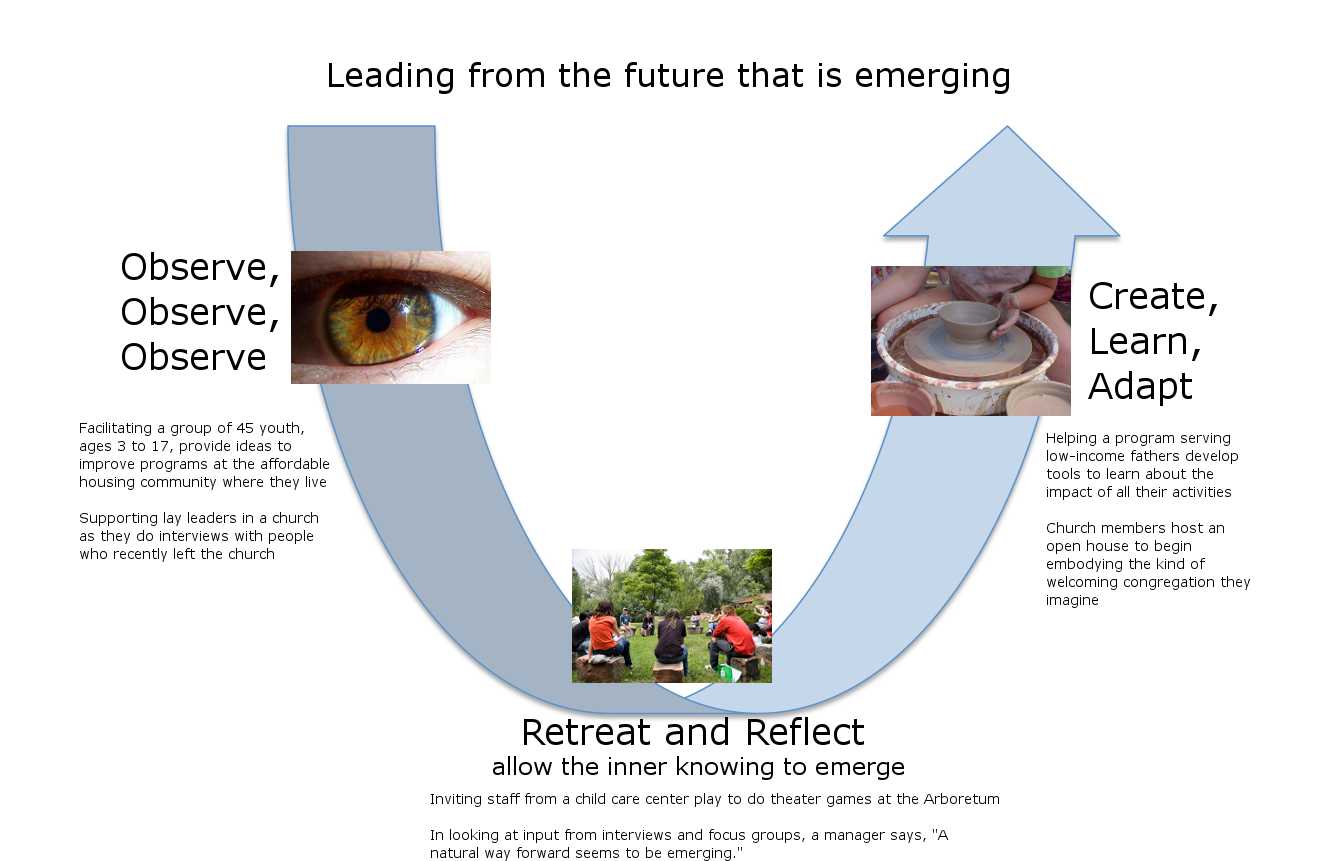
Click on the image to see the full size.
Friday, February 5, 2010
Getting out of the box of your job (or joblessness)
 I think that more and more of us will need to live without jobs. Lots of research & statistics tell us this. This could be a good thing. While there won't be as many jobs, we still need to work and take care of each other.
I left my full-time job a year and a half ago. Since then, I've been a lot happier, learned a lot, done some good work, and made enough money (though less money than before).
Without a full-time job, my work has often had a different relationship with money:
- My family sometimes does work as a barter. Right now a friend is fixing our bathtub. As part of his payment, my wife will take photos of his family.
- I sometimes do work as marketing. I make presentations about spirituality and leadership. I tell people they can hire me as a consultant for their organization.
- I do work because I love what I'm doing and/or I love who I am doing the work with and for. I organized a forum about faith and organizations because I'm passionate about that topic.
- I do work because someone around me needs something. I have the flexibility to take someone in my faith community to the hospital.
- I do work that builds relationships and social capital. I help a friend make a web-site. That friend connects me to an organization that contracts with me for strategic planning.
- I do work to learn. I co-facilitate a discernment group at a church, and I learn new ways groups can deepen personally and improve the church at the same time.
- I do work because I think God is asking me to do it. I facilitate a spirituality group at a treatment center.
- And, yes, I do work to earn money. I do some projects through paying contracts. Sometimes I might ask for donations to support projects I'm doing.
A range of groups are pioneering how to draw on this broader range of motivations for work. The free classes offered by Exco College are an example here in the Twin Cities. The millions of people who write for Wikipedia are an example on a larger scale. These groups are tapping into a growing group of freelance entrepreneurs who give for reasons other than money.
We all come at this dynamic with different kinds of privileges and challenges. I had the luxury of being able to choose to leave my job. On the other hand, I have learned the most about creatively and faithfully serving those around us from a friend of mine who was recently homeless and has been unable to find paying work for a long time.
How are you getting out of the box of your job (or out of your unemployment) to offer what is most needed around you?
Wednesday, January 13, 2010
The collapse of ego-based institutions
In this 5 minute video from Eckart Tolle about "The Current Economy," he talks about the collapse of ego-based institutions, and the shift in consciousness that can inform new ways of being. His talk resonates with my passion for the transformation of the "spirit of institutions."
Wednesday, January 6, 2010
Upcoming Events in the Twin Cities: Spirit of Institutions
January 24: "Spiritual Grounding in Secular Organizations" Adult Education session at Twin Cities Friends Meeting (1725 Grand Ave., St. Paul), 9:45 am - 10:45 am. We will explore how Quaker practices for personal and collective discernment can be translated in our work within secular organizations. Open to all.
February 22: Twin Cities Theory U/Presencing Networking Gathering at Common Roots Cafe (2558 South Lyndale Avenue, Mpls), 6:00 pm - 7:30 pm. An informal gathering I'm organizing for people interested in the "letting go, letting come" process of Theory U as described by Otto Scharmer. RSVP to Michael if you'd like to come.
February 22: Twin Cities Theory U/Presencing Networking Gathering at Common Roots Cafe (2558 South Lyndale Avenue, Mpls), 6:00 pm - 7:30 pm. An informal gathering I'm organizing for people interested in the "letting go, letting come" process of Theory U as described by Otto Scharmer. RSVP to Michael if you'd like to come.
Subscribe to:
Posts (Atom)